If you are regularly using artificial tears, only to feel that familiar, scratchy, or burning sensation again a few minutes later, you are not alone. Many of our patients suffer from chronic dry eye, yet many think of it like a temporary inconvenience. Our understanding of dry eye disease has evolved greatly over the last few years.
You might assume that any dry eye drop will provide relief, but if you are using them daily with little improvement, you are likely treating the symptoms rather than the root cause.
Here is the science behind why your eye drops are failing and the advanced technology—LipiFlow—that is designed to actually fix the problem.
1. Why Eye Drops Are Not a Long-Term Solution
Over-the-counter (OTC) artificial tears are designed to supplement your natural tears. They are great for temporary lubrication, but they have major limitations:
- They Don’t Fix the Root Cause: 80% or more of chronic dry eye is caused by Meibomian Gland Dysfunction (MGD). Eye drops cannot unclog blocked glands or restore proper oil flow; they only add water to an already unbalanced tear film.
- They Evaporate Too Fast: If you lack the oil layer of your tears, the “water” you put in will simply evaporate, leaving your eyes just as dry as before.
- Preservatives Can Make It Worse: Many artificial tears contain preservatives that, with frequent use, can actually cause more irritation and damage to the ocular surface.
2. The Most Common Issue: Meibomian Gland Dysfunction (MGD)
To understand why drops fail, you need to understand how tears work. A healthy tear film has three layers: water, mucus, and oil. The oil is crucial—it prevents the water layer from evaporating.
These oils are produced by the Meibomian glands, tiny structures located inside your eyelids.
- What happens in MGD: As we age, or due to factors like contact lens use, screen time, or inflammation, the oil in these glands hardens (like butter in the fridge) and blocks the gland opening.
- The Result: The oily layer is missing, tears evaporate instantly, and the eye becomes inflamed, red, and irritated.
Eye drops do not fix a physical blockage. They only add more water to a leaky bucket.
3. The Science Behind LipiFlow: Treating the Cause of dry eyes
If MGD is the root cause, you need a treatment that clears the blockage. LipiFlow is an FDA-cleared, in-office procedure designed specifically for this.
LipiFlow uses a technique called Vectored Thermal Pulsation (VTP). Here is the science behind it:
- 12-Minute In Office Painless Procedure: A sterile, single-use, applicator (feels like a contact lens) is placed over your eyelid. It is designed to vault over the cornea, protecting the eye itself.
- Precise, Controlled Heat: The device applies a consistent temperature of 42.5°C (108.5°F) directly to the inner eyelid—where the glands are located. This heat melts the hardened, “stagnant” oil (meibum) that has blocked the glands.
- Gentle Pulsating Pressure: While the oil is being heated, the device applies a carefully calculated, pulsating massage to the outer eyelid.
- Unblocking the Glands: The combination of heat and pressure expels the blockage from the gland ducts, restoring natural oil flow to the tear film.
Unlike daily drops, one LipiFlow treatment can provide relief for 1-4 years. After using the Lipiflow treatment in our office over the last 8 years, most of our patients are comfortable for about 2 years. Some can be comfortable and use occasional artificial tears for as long as 4 years. In our experience, our heavy device users repeat the treatment yearly. It all depends on your gland structure and how you use your eyes. As in all of healthcare, early diagnosis and treatment gets the best outcomes.
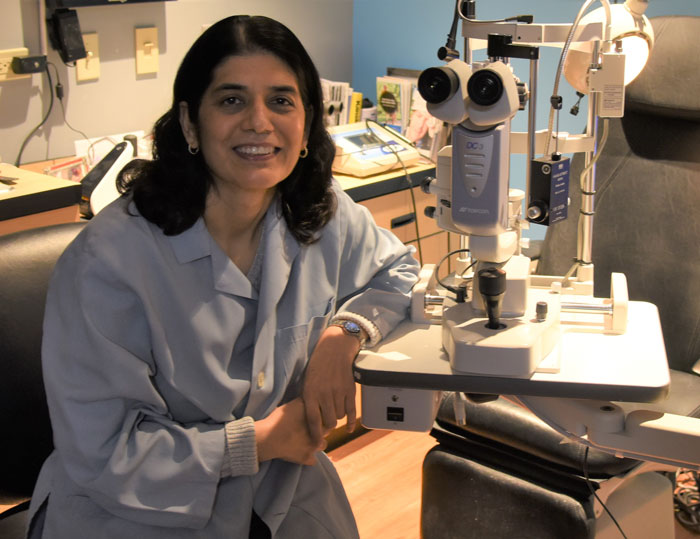
4. Why You Should See Dr. Kapoor:
Because MGD is a chronic, progressive condition, it is vital to get a proper diagnosis. Dr. Kapoor uses advanced imaging, such as a LipiScan and the Firefly system to check your gland structure and function. Based on the findings she recommends the most appropriate treatment for you.